
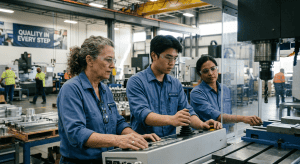
The workforce transition now underway in manufacturing is not a distant forecast. It is already in progress, and the numbers are specific enough to demand attention.
According to The Manufacturing Institute’s 2025 State of the Manufacturing Workforce report, approximately 25% of the U.S. manufacturing workforce is 55 or older, representing roughly 12 million workers at or approaching retirement age.
The same report projects that the industry will need to fill more than 3.8 million jobs over the next decade, with nearly half of those positions potentially remaining vacant due to a structural workforce deficit that hiring alone cannot solve.
When a senior technician with 30 years of experience on a specific production line retires, the loss extends well beyond a headcount adjustment. As dirac.com’s guide to preserving tribal knowledge in manufacturing notes, what leaves with that person includes undocumented troubleshooting shortcuts, an intuitive understanding of how individual machines behave under specific conditions, and process optimizations that never made it into any manual.
The challenge for manufacturers is not simply replacing workers. It is replacing the knowledge those workers carry. A new hire can be trained on procedure, but the judgment, pattern recognition, and situational awareness that experienced workers build over decades cannot be conveyed through onboarding alone.
The manufacturers that recognize this distinction and act on it before worker retirements accelerate are the ones that maintain quality, consistency, and productivity through the transition. The ones that wait treat every departure as a surprise, even when it might be years in the making.
The Midwest is feeling this pressure with particular intensity, and the numbers from one state illustrate just how concentrated that risk has become.
The next post in this series uses Illinois as a case study to show what demographic and economic pressure looks like at the regional level for manufacturing.