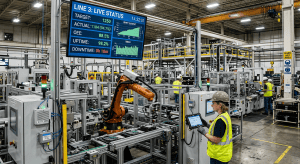
The integration of Industry 4.0 technologies is reshaping how knowledge is generated and stored in the factory environment. Small and medium-sized manufacturers are increasingly adopting smart manufacturing concepts such as integrating the Industrial Internet of Things (IIoT), artificial intelligence (AI), and real-time data analytics into their production environments. These technologies do not replace the need for knowledge management; they provide new mechanisms for the externalization of tacit knowledge into explicit data sets.
National Institute of Standards and Technology (NIST) indicates one of the most significant trends is the transition from preventive maintenance to AI-powered predictive maintenance. Traditional maintenance models rely on scheduled downtime based on time intervals, which often results either in unnecessary maintenance or unexpected failures. Predictive maintenance uses AI-driven tools and IIoT sensors to monitor equipment in real-time, predicting when a machine is likely to fail and allowing for interventions before a breakdown occurs. This methodology captures the knowledge of the machine’s state, translating sensor data into actionable maintenance schedules that minimize costly downtime.
Similarly, NIST indicates AI-driven quality control is becoming a standard methodology for identifying patterns in production data that indicate emerging defects. By automating the analysis of regulations and technical documents, small and medium-sized manufacturers can reduce human error and improve traceability, which is critical for compliance in sectors like aerospace, defense, and medical device manufacturing.
The manufacturers that treat Industry 4.0 as a knowledge management opportunity rather than a purely capital investment are the ones positioned to capture its full value.
This table provides examples of the benefit to small and medium-sized manufacturers of the collaboration between Industry 4.0 technology and knowledge management.
| Industry 4.0 Technology | Functional Role in Knowledge Management | Small- Medium-sized Manufacturing Benefit |
| Artificial Intelligence (AI) | Automates analysis of technical documentation and process data | Reduces human error and streamlines regulatory reporting. |
| Digital Twins | Provides virtual simulations of facility layouts and production lines | Allows for testing improvements without disrupting production. |
| Cloud Computing | Centralizes information for instant, multi-location access | Enhances collaboration between departments and remote sites. |
| Additive Manufacturing | Enables rapid prototyping and on-demand production | Reduces inventory costs and speeds time-to-market. |
Understanding how knowledge moves through a manufacturing company requires a framework. One model has become the foundation of serious knowledge management practice worldwide.
The next post introduces the SECI model and explains how it describes the movement of knowledge between people and systems in a manufacturing environment.