Most manufacturing companies manage knowledge transfer informally. The SECI model makes that process visible, structured, and manageable.
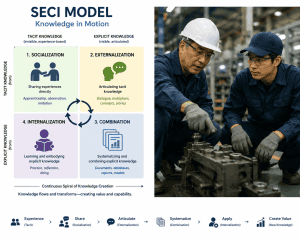
Developed by Ikujiro Nonaka and Hirotaka Takeuchi, the SECI model is the gold standard for understanding how knowledge is created and managed within an organization. The model is based on the interaction between two types of knowledge: tacit knowledge (unwritten experiential, and intuitive) and explicit knowledge (codified, documented, and formal).
The SECI framework identifies four processes of knowledge conversion.
- Socialization (Tacit to Tacit): This process involves passing knowledge between people through shared experiences, such as spending time together or working in the same environment. In manufacturing, this is demonstrated by traditional apprenticeships and “shadowing” where a junior employee learns about a machine watching a senior operator.
- Externalization (Tacit to Explicit): This is converting tacit knowledge into specific formats, such as manuals, guides, checklists, or digital instructions. Externalization is a critical step for manufacturers facing retirements because it captures the shortcuts and troubleshooting techniques that might be lost.
- Combination (Explicit to Explicit): Once knowledge is documented, it can be combined with other explicit sources. An example is relating shop-floor data to industry standards or quality records to create more complex and systematic knowledge sets.
- Internalization (Explicit to Tacit): This process occurs when employees read and apply explicit knowledge until it becomes part of their own tacit skillset. For instance, when a new hire follows a digital instruction guide multiple times, there is no longer a need to look at it. The explicit knowledge is absorbed through repeated practice. The knowledge is internalized and becomes tacit skill again.
For a small manufacturer, the SECI framework means knowledge is constantly being created and refined.
- The tacit wisdom of a retiring welder (Socialization) is recorded into a video guide (Externalization), which is then integrated into the company’s digital training platform (Combination) and used to train a new hire who eventually develops their own expertise (Internalization), starting the cycle anew.
Capturing knowledge is only part of the solution. Sustaining that knowledge inside the facility after it is captured requires a different kind of structure.
The next post examines Communities of Practice and how they keep knowledge active and accessible long after a formal capture effort concludes.